
WooCommerce powers one in three online stores. 33.4% of the e-commerce market. $35 billion in annual gross merchandise value. For millions of businesses, it is the default. But defaults deserve scrutiny.
In our deep dive on WordPress, we covered why the platform still dominates the web. In our CMS comparison, we reviewed fourteen platforms across every use case. This article focuses exclusively on e-commerce: nine platforms compared on cost, performance, scalability, and real-world fit.
We build WooCommerce stores. We have migrated clients away from WooCommerce. We have also migrated clients to it. This is not advocacy. It is analysis.

WooCommerce in 2026: what has changed
WooCommerce is not the same platform it was three years ago. The most significant change is High-Performance Order Storage (HPOS), now the default since WooCommerce 8.2. HPOS replaces the old WordPress post meta table with dedicated commerce tables, cutting order query times by up to 80% on stores with large order volumes.
The block-based checkout and cart have replaced the legacy shortcode approach. Cart and checkout pages now use the block editor, making layout customization possible without code or third-party page builders. For developers, this means fewer compatibility headaches. For merchants, it means more control over the conversion funnel.
Headless WooCommerce is now a real option. The REST API has matured, and WPGraphQL enables decoupled frontends built with Next.js, Nuxt, or Astro. This lets teams keep WooCommerce as the commerce engine while building a custom storefront that scores 95 or higher on PageSpeed.
AI-powered product recommendations are arriving through both WooCommerce-native features and third-party plugins. WordPress 7.0's native AI capabilities extend to product descriptions, SEO metadata, and automated customer support. The average WooCommerce store now loads in 2.8 seconds, down from 4.1 seconds in 2023 on comparable hosting, thanks to HPOS, Cart Fragments optimization, and modern managed hosting.
The agentic commerce shift: a new selection axis
The biggest change since this comparison first published is not a pricing tweak. It is a new sales channel. In late 2025, OpenAI and Stripe co-developed the Agentic Commerce Protocol (ACP), an open standard that lets an AI agent complete a purchase inside the conversation. ChatGPT Instant Checkout launched with US Etsy sellers on September 29, 2025. OpenAI said it planned to add more than a million Shopify merchants, but that rollout stayed limited and was scaled back by March 2026. The detail that matters for platform economics: OpenAI charges merchants a 4% fee on every completed Instant Checkout sale, on top of normal payment processing, per reporting from PYMNTS and Retail Brew around the January 2026 Shopify pilot. For thin-margin sellers, that reframes the entire transaction-fee calculus we laid out above.
Platform choice now carries a second question beyond cost and scale: how agent-ready is it? Shopify has moved fastest. In its Q1 2026 earnings, reported May 5, 2026, it said AI-driven traffic to its stores grew about eight times year over year, orders from AI-powered searches grew nearly thirteen times, and it has structured more than one billion products so AI agents read accurate price and inventory data. Traffic from that clean catalog converts at twice the rate of general AI searches. WooCommerce is not standing still: it is a launch partner for Stripe's Agentic Commerce Suite, announced December 2025, added Model Context Protocol support in developer preview for programmatic product and order management, and shipped WooCommerce 10.8 on May 26, 2026 with WordPress 7.0 readiness. The headless platforms, Medusa and Saleor, are structurally well placed here because an API-first backend is exactly what an agent needs to query. The takeaway for 2026: whatever platform you pick, your product catalog has to be machine-readable, because a growing share of buyers will never see your storefront at all.
The real cost of WooCommerce
WooCommerce is free to install. It is not free to operate. The total cost of ownership depends on your hosting, your plugin stack, and whether you manage it yourself or hire a developer. Here is what a realistic breakdown looks like.
Hosting: $15 to $80 per month. Shared hosting works for small stores under 5,000 products. Managed WooCommerce hosting ($40 to $80 per month) is necessary for stores that need reliability and speed. SSL: Free via Let's Encrypt on most hosts. Theme: $0 to $80 one-time. Essential plugins: $200 to $600 per year, covering SEO, backups, security, and advanced shipping or payment features. Payment processing: 2.9% plus $0.30 per transaction through Stripe or PayPal, but zero platform transaction fees. Developer maintenance: $50 to $200 per month if outsourced, or $0 if self-managed.
Total realistic cost: $80 to $150 per month for a small store. $200 to $400 per month for a mid-size operation.
Compare that to Shopify. The advertised "starting at $39 per month" ignores transaction fees (2% on Basic for non-Shopify Payments), app costs ($50 to $200 per month for essential apps), and theme costs. A realistic Shopify store costs $150 to $350 per month before transaction fees compound.
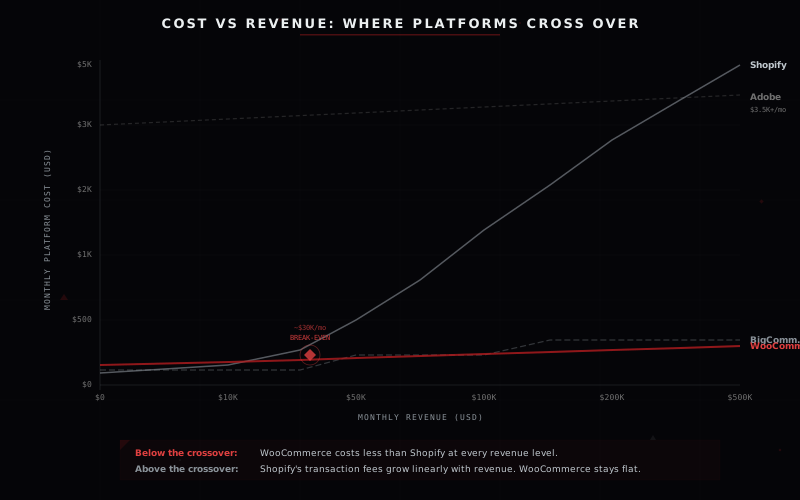
The critical difference: WooCommerce's cost is front-loaded (setup and configuration) while Shopify's cost is revenue-dependent (transaction fees scale with every sale). At $50,000 per month in revenue, WooCommerce's platform cost stays around $1,500 to $2,000 per year. Shopify Basic charges $6,000 to $12,000 per year in transaction fees alone, on top of the monthly plan.

The platforms, ranked by use case
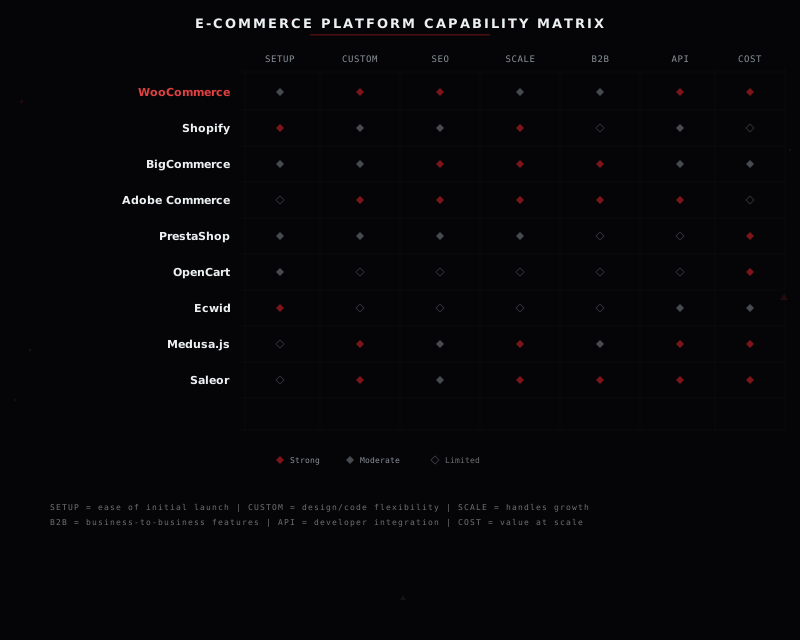
We evaluated nine platforms across seven dimensions: ease of setup, customization depth, SEO capability, scalability, B2B features, API maturity, and cost at scale. No affiliates. No sponsorships. Just the platforms we have built with, migrated between, and recommended to clients.
WooCommerce
33.4% of the e-commerce market. Free core. 59,000 or more extensions. Zero platform transaction fees. WooCommerce is WordPress's e-commerce layer, and it inherits everything that makes WordPress powerful: a massive developer pool, infinite customization, and complete data ownership. You control the server, the database, and every line of code.
The strengths are real. No platform takes a percentage of your sales. You own your customer data outright. SEO benefits from WordPress's mature content architecture. The plugin ecosystem covers every use case from subscriptions to bookings to multi-vendor marketplaces, and it extends to deep back-office work like syncing a storefront with a Dolibarr ERP for automated stock and invoicing.
The trade-offs are equally real. You are responsible for security updates, hosting performance, and plugin compatibility. Performance depends entirely on your hosting quality and optimization discipline. Without a developer (or the willingness to learn), the setup curve is steep.
Best for: businesses wanting full ownership, stores under $50K per month revenue, teams with WordPress experience. Skip if: you have no developer and no budget for one.
Shopify
14.6% to 19% market share. $39 to $399 per month. 0.5% to 2.0% transaction fees on third-party payment providers. Shopify is the fastest path from zero to selling. Hosting, SSL, PCI compliance, and checkout optimization are all included. Shop Pay, Shopify's accelerated checkout, consistently delivers the highest conversion rates in the industry.
The app ecosystem (8,000 or more apps) covers nearly every need, and Shopify Magic provides native AI for product descriptions, email campaigns, and customer segmentation. The platform scales effortlessly; you never worry about server capacity.
The cost of that convenience compounds. Transaction fees of 0.5% to 2.0% on every sale (unless you use Shopify Payments exclusively) add up fast. At $100,000 per month in revenue, Basic plan transaction fees alone exceed $24,000 per year. Shopify Plus at $2,300 per month reduces fees but adds substantial fixed cost. FX conversion fees of 1.5% to 2% on international sales add another hidden layer. Customization requires Liquid templating, a proprietary language with a smaller talent pool than PHP or JavaScript.
Best for: DTC brands prioritizing speed to market, stores over $50K per month where Shopify Plus unlocks checkout customization. Skip if: margins are thin and transaction fees matter.
BigCommerce
$29 to $399 per month. Zero transaction fees on every plan. The strongest native B2B features outside enterprise tiers. BigCommerce is the platform that Shopify merchants discover when transaction fees start hurting.
Built-in B2B capabilities include customer groups, bulk pricing, purchase orders, quote management, and company accounts, all available without upgrading to enterprise pricing. Multi-storefront support lets you run B2B and B2C operations from a single backend. Sixty-five or more payment gateway integrations cover 250 local payment methods in over 100 countries.
The trade-offs: fewer themes than Shopify, a steeper learning curve, and a smaller app ecosystem (1,000 apps vs Shopify's 8,000). Brand recognition is lower, which means fewer pre-built integrations from third-party SaaS tools.
Best for: B2B e-commerce, multi-storefront operations, high-volume sellers allergic to transaction fees. Skip if: you need the largest app ecosystem or the simplest possible setup.
Adobe Commerce (Magento)
$40,000 to $450,000 or more per year. 9.2% market share. Enterprise powerhouse. Adobe Commerce is what you deploy when the other platforms cannot handle your complexity. Multi-site from a single instance. Advanced B2B workflows. Unlimited scalability for catalogs with hundreds of thousands of SKUs.
The free Magento Open Source edition exists, but real-world costs (hosting, development, extensions, maintenance) still run $5,000 to $90,000 or more per year. Adobe Commerce Cloud starts at roughly $40,000 per year for stores under $1 million in gross merchandise value, and scales with revenue. The latest 2.4.9 beta brings PHP 8.5 support and improved cloud deployment.
This is not a platform for small businesses. Implementation takes months, not weeks. You need dedicated Magento developers, and they cost more than generalist PHP developers due to the specialized skill set.
Best for: enterprise operations with $10M or more in annual revenue, complex B2B catalogs, multi-brand portfolios. Skip if: your annual revenue is under $5 million.
PrestaShop
Free, open-source. European stronghold. Declining global market share. PrestaShop holds roughly 1.9% of the global e-commerce market, but that number obscures its real strength: in France, Spain, and Italy, PrestaShop dominates local commerce. 61.3% of local-domain e-commerce sites in those markets run PrestaShop.
The platform offers native multistore, multilingual, and multi-currency support without plugins. Catalog management is more structured than WooCommerce out of the box. For European SMBs selling primarily within the EU, PrestaShop's architecture is purpose-built.
The decline is real: only 9,747 new shops launched on PrestaShop in early 2026, compared to 148,044 on Shopify and 99,140 on WooCommerce. Module development has slowed. The English-speaking community is smaller. For new projects in 2026, PrestaShop is a legacy choice that works well if you are already on it, but is harder to recommend for greenfield stores.
Best for: European SMBs selling primarily within the EU. Skip if: you are targeting global markets or need English-language support resources.
OpenCart
Free, open-source. 0.1% market share. 178,881 live websites and declining. OpenCart is lightweight, simple to administer, and runs on minimal server resources. For very small stores with basic catalog needs and a developer who already knows the codebase, it still works.
But the ecosystem is shrinking. Extension quality is inconsistent. Community support has deteriorated, with developers reportedly unresponsive while the community forums carry the weight. Security updates lag behind more actively maintained platforms. Performance issues require manual optimization that most small business owners cannot handle.
Best for: existing stores with sunk development costs where migration would cost more than maintenance. Skip if: you are starting fresh in 2026. Better alternatives exist at every price point and complexity level.
Ecwid (Lightspeed)
Free to $99 per month. Add e-commerce to any existing website without rebuilding. Ecwid is not a standalone platform. It is an embeddable storefront that drops into any site: WordPress, Wix, Squarespace, a static HTML page, even a social media profile. If you already have a content site and want to sell products without replacing your entire stack, Ecwid is the cleanest path.
The Lightspeed POS integration enables omnichannel sync between online and physical retail. Multilingual support is built in. Setup takes hours, not weeks. But the trade-offs match the simplicity: limited customization, SEO limitations from JavaScript-rendered catalogs, and dependency on Lightspeed's product roadmap.
Best for: adding a small shop to an existing content site without rebuilding. Skip if: e-commerce is your primary business. Use a dedicated platform instead.
Medusa.js
Free, open-source, Node.js. 32,000 or more GitHub stars. 33.4% month-over-month community growth. Medusa.js is the most-watched headless e-commerce framework in 2026. It is composable, modular, and built for developers who want to own every layer of the customer experience.
The architecture is headless-first: Medusa handles the commerce engine (products, orders, payments, fulfillment) while you build the storefront with any frontend framework. Next.js, Nuxt, React Native, or a custom stack. REST and GraphQL APIs are both available. Enterprise adoption is growing, with Heineken and Mitsubishi among confirmed users.
The cost is developer time. There is no visual admin panel for non-technical users (though a dashboard exists for order management). Every storefront customization requires code. Self-hosting means you manage infrastructure. For teams without strong Node.js expertise, the learning curve is steep.
Best for: developer teams building custom storefronts, brands wanting full control over the customer experience. Skip if: you need a visual admin panel or non-technical staff managing the store daily.
Saleor
Free, open-source. Python and Django backend. GraphQL-first API. Saleor is the headless alternative for teams that think in Python rather than JavaScript. The GraphQL API is the most mature in the headless e-commerce space, enabling efficient data queries and strong typing that catches integration errors at build time rather than runtime.
Multi-channel capabilities are native: per-channel pricing, currencies, and stock control. The included dashboard provides a functional admin interface, unlike some headless platforms that require building everything from scratch. For enterprise teams with existing Python and Django infrastructure, Saleor integrates naturally.
Deployment is complex: Docker, PostgreSQL, Redis, Celery, and typically Kubernetes for production. The community is smaller than Medusa's (2.1% month-over-month growth vs 33.4%). If your team is JavaScript-native, Medusa is the more natural choice.
Best for: teams with Python and Django expertise building multi-channel commerce. Skip if: your team is JavaScript-native. Consider Medusa instead.
How we choose for our clients
Five factors drive every recommendation: monthly revenue, team technical capacity, geographic market, product catalog complexity, and growth trajectory. No single factor decides it. The combination does.
Budget under $2,000, no developer, under 100 products? Shopify or Ecwid. Shopify if e-commerce is the primary business. Ecwid if you already have a content site and just want to add a store.
Revenue under $50,000 per month with a developer available? WooCommerce. Zero transaction fees and full control over the stack make it the lowest-cost option at this scale. We covered this in detail in our WordPress article.
Revenue $50,000 to $500,000 per month, DTC brand? Shopify Plus or BigCommerce. Shopify Plus if checkout conversion rate matters most. BigCommerce if transaction fees are unacceptable or B2B features are needed. At this revenue tier, the platform rarely decides growth. Paid acquisition does. For ecommerce at this scale, our Google Ads management team runs Shopping, Performance Max, and retargeting across both platforms. For the full 2026 playbook, see our deep dive on Google Ads for e-commerce in 2026.
Revenue over $500,000 per month, B2B, multi-brand? Adobe Commerce. The cost is extreme, but nothing else handles the complexity of enterprise multi-site B2B operations with the same depth.
Custom storefront with a development team? Medusa.js for JavaScript teams. Saleor for Python teams. Both provide the flexibility of building exactly what you need without platform constraints.
European SMB already on PrestaShop? Stay on PrestaShop if it works. Migrate to WooCommerce if you are expanding beyond EU borders.

The best e-commerce platform is the one that costs the least to operate at your specific revenue level, matches your team's technical capacity, and does not punish you for growing. We have no affiliate relationships with any platform listed here. We build on whichever tool makes the most money for our clients.
Frequently asked questions
Is WooCommerce still worth it in 2026?
Yes, for stores under $50,000 per month in revenue with developer access. Zero platform fees and full data ownership make it the lowest total-cost-of-ownership option at moderate scale. Above that threshold, evaluate whether managed infrastructure from Shopify or BigCommerce reduces your operational burden enough to justify the premium.
WooCommerce vs Shopify: which is cheaper?
It depends on revenue. Below roughly $30,000 per month, WooCommerce wins because it charges zero platform transaction fees. Above $100,000 per month, Shopify Basic charges over $24,000 per year in transaction fees alone, making WooCommerce significantly cheaper. Shopify Plus at $2,300 per month changes the math again by reducing transaction fees, but adds a substantial fixed cost.
What is the best open-source e-commerce platform?
WooCommerce for traditional stores with WordPress integration. Medusa.js for headless, developer-first storefronts built on Node.js. Saleor for GraphQL-first architectures with Python and Django backends. PrestaShop remains viable for European SMBs, though its growth has slowed significantly.
Can WooCommerce handle 100,000 products?
Yes, with HPOS enabled, proper hosting (dedicated or managed WooCommerce), and database optimization. Default shared hosting will struggle past 10,000 SKUs. The platform itself has no hard product limit. The bottleneck is always infrastructure and database design, not WooCommerce itself.
Should I switch from WooCommerce to Shopify?
Only if the maintenance burden of self-hosting exceeds Shopify's ongoing cost including transaction fees. Calculate your actual total cost of ownership for both platforms before deciding. Factor in plan fees, transaction percentages, app subscriptions, and the value of your development time. For most stores under $50,000 per month, the switch costs more than it saves.
What is the best e-commerce platform for B2B?
BigCommerce has the strongest native B2B features: customer groups, quote management, purchase orders, and bulk pricing on non-enterprise plans. Adobe Commerce offers the deepest B2B customization for enterprises with $10 million or more in annual revenue. WooCommerce with B2B-specific plugins works for budget-conscious operations that need flexibility over built-in features.
Need an e-commerce store that actually converts?
We build WooCommerce stores, Shopify storefronts, and custom headless commerce solutions. Tell us your revenue target and we will recommend the right platform.

